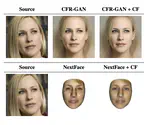
Biometric facial recognition models often demonstrate significant decreases in accuracy when processing real-world images, often characterized by poor quality, non-frontal subject poses, and subject occlusions. We investigate whether targeted, AI-driven, head-pose correction and image restoration can improve recognition accuracy.
Using a model-agnostic, large-scale, forensic-evaluation pipeline, we assess the impact of three restoration approaches:
- 3D reconstruction (NextFace)
- 2D frontalization (CFR-GAN)
- Feature enhancement (CodeFormer)
We find that naive application of these techniques substantially degrades facial recognition accuracy. However, we also find that selective application of CFR-GAN combined with CodeFormer yields meaningful improvements.
Our findings have important implications for the forensic use of facial recognition systems, demonstrating that context-aware decisions about when and how to intervene on images are crucial for improving recognition performance.